









Safety and Security
Our team followed a “safety first” principle throughout the project: experimental safety, product safety, Human Practices activity safety, and related areas.
We work under iGEM Safety Policies and the iGEM Safety Rules.
Overview
Safety is recognized by everyone around the world as the most important thing to pay attention to, whether it is about personal safety or environmental safety. Therefore, our team followed the principle of “safety first” throughout the entire project. We put effort into experimental safety, product safety, HP activity safety, and other areas to make sure our project is safe.
Safety Philosophy
Our team’s safety philosophy covers molecular design, laboratory work, and real-world application.
At the molecular design level, we follow safety-by-design principles. We use a non-pathogenic BSL-1 host strain and remove dangerous genetic parts to lower risks from the very beginning.
At the laboratory practice level, all team members complete biosafety training and follow BSL-1 and iGEM rules. We employ closed-containment facilities and standard waste disposal protocols to avoid the escape of any engineered organisms. At the application and society level, we evaluate the risks of environmental impact for our prototype. We also consider ethics and relevant regulations. We keep complete records of all risk assessments, so we can protect people, the public, and the environment while innovating.
Laboratory
Our team works in a Biosafety Level 1 (BSL-1) laboratory. This is the lowest protection level in the four-level biosafety system. It is used for working with microorganisms that do not cause disease in healthy adults, and it is commonly used for teaching, basic molecular biology, and general microbiology experiments.
Before starting formal experiments, to ensure safe use of the lab and to make sure all team members pay attention to lab safety, everyone on our team received lab training. The lab supervisor personally taught us the safety rules, such as how to properly use biological instruments and sterile workbenches, and guided each team member through hands-on practice. After that, all team members took a small test to check their familiarity with lab equipment and their ability to assess experimental safety. Students who did not pass received extra training and reminders to make sure both the lab and the people in it stay safe.
Biological Safety
Even when working in this lab setting, handling engineered microorganisms can still bring risks, such as accidental release, skin contact with microbes, potential biological exposure, and incomplete sterilization that could let microorganisms enter the outside environment.
So we made a response plan: everyone wears lab coats, gloves, and safety goggles, and performs all operations inside a biological safety cabinet. All used bacterial liquid and cell waste are sterilized at 121°C under high pressure before being thrown away. Lab surfaces are disinfected with 75% alcohol, and we keep the living area separate from the lab area. Eating and drinking are strictly forbidden in the lab area.
In addition, our products and genetic parts could potentially become toxic through operations like PCR or plasmid transfer.
To avoid this, we only use two non-pathogenic Risk Group 1 organisms: E. coli DH5α and BL21 to express our proteins. We do not use vectors that contain disease-causing genes or virulence factors. None of our parts are hazardous, and when assembled together, they do not create any dangerous functions.
Chemical Safety
Some chemical solvents used in experiments, such as strong acids, strong bases, dyes, and nucleic acid solutions, can be highly corrosive and toxic, which may threaten human health.
Therefore, we wear nitrile gloves, lab coats, and safety goggles, and we choose less toxic chemicals whenever possible. When we absolutely must use highly hazardous reagents, we do so under the supervision of our teacher, with full protective equipment, and inside a fume hood. The lab also has clear labels on containers indicating their contents and hazard levels, such as strong acid and strong base labels.
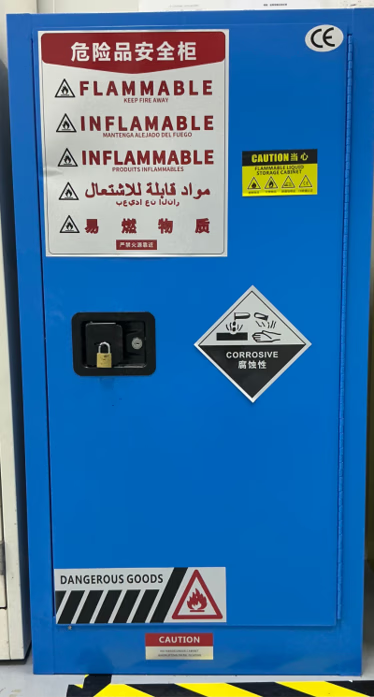
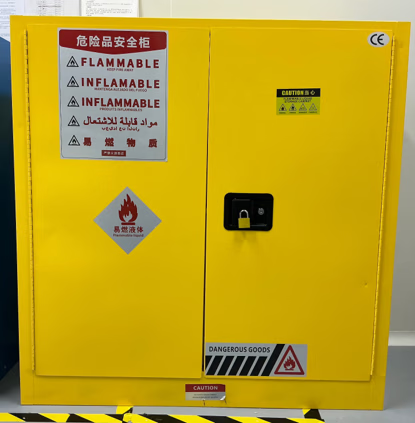
Also, there are flammable and explosive chemicals in the lab, such as ethanol and methanol organic solvents.
So during experiments, we keep all operations away from ignition sources and clearly mark flammable and explosive materials.
Physical Safety
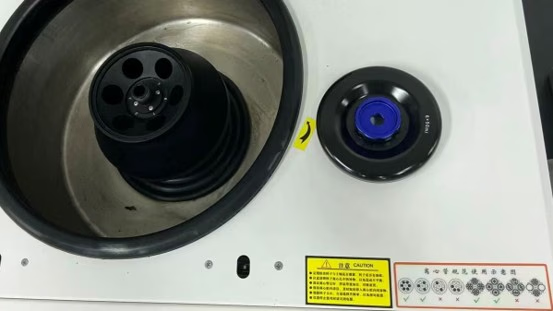
In addition, the safety risks from laboratory equipment cannot be ignored. Ovens can have high temperature and high pressure, centrifuges can become unbalanced, and water baths can be dangerously hot. All of these can cause serious physical harm.
So we require all team members to strictly follow operating procedures, such as balancing the centrifuge properly and keeping electrical equipment dry.
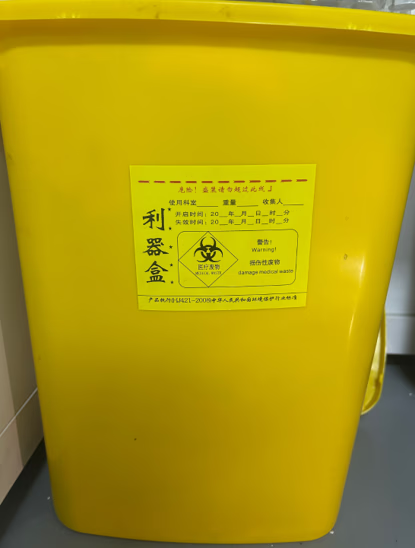
Sharp objects like scissors and blades are unavoidable in experiments, and broken glass from beakers can also pose physical threats.
Therefore, we collect sharps in a special container and pay extra attention when handling glass containers. When dealing with broken glass, we wear thick gloves and collect all glass pieces together for proper disposal.
Product Safety
The original goal of our team’s bio-nail product, Younailit, is to solve the harm that traditional nail products cause to human health and the environment. So we pay special attention to the safety of our product.
In our experiments, we only use non-pathogenic E. coli DH5α and BL21 to express chromoproteins, mucins, and biomaterials. The final product contains only collected proteins, with no live engineered bacteria.
We wanted to use human fingernails to test the stability and safety of our product. However, after reading Rule 11 of the Safety Rules and the Human Experimentation Policy, we learned that we would need to submit a consent form to use human samples. So we contacted iGEM Headquarters to ask for permission, but they refused.
The reason is that as a high school team, if we do not follow proper procedures when collecting samples, we could threaten the health of the sample donors, for example by exposing them to viruses on equipment. We also read and summarized the requirements for obtaining human samples.
Therefore, during the experiment period, we did not apply the nail product to any person’s nails or body. We also did not use any animal shells, did not use any organisms outside the white list, and followed the iGEM Code of Conduct to avoid potential allergy risks from animal-derived materials and ethical issues with human tissue.
Our bio-nail product is safer and more environmentally friendly than traditional nail products. It does not produce harmful substances or gases, and its removal process causes much less damage to the natural nail and skin. In addition, all materials we produce are biodegradable and can be broken down by microorganisms in the environment without releasing harmful substances. This solves the environmental pollution problems of traditional nail products, such as waste gas and toxic substances released during plastic processing. However, one downside is that the nano-hydroxyapatite used to make the manicure can produce nanoscale particles when sanding the nails and could enter the respiratory tract and affect breathing. After researching, we found that wearing an N95 mask correctly can filter 95% of particles, which can effectively prevent these dust particles from entering the body.
Human Practices Safety
While doing experiments, we also continued our Human Practices work. For interviews, we explain our purpose to the interviewees beforehand, keep important information confidential, and ask them if they are willing to appear in our project. In our interview summaries, we do not change or guess the content of the interviews. For social surveys, we do not disclose the personal information of survey respondents. When sharing information through media, we make sure the content is healthy and reasonable, without exaggeration or false claims. In addition, before making our team’s promotion video, all people appearing in the video gave their consent, and for any scenes involving children, we obtained permission from their guardians.
References
- Innovations, Challenges and Future Directions of T7 RNA Polymerase in Microbial Cell Factories. ACS Synthetic Biology.
- Associations between Size-Specific Particulate Matter and Lung Function: Results from the China Pulmonary Health Study. Environment & Health.
- Respirator Performance against Nanoparticles under Simulated Workplace Activities. PMC5504519.